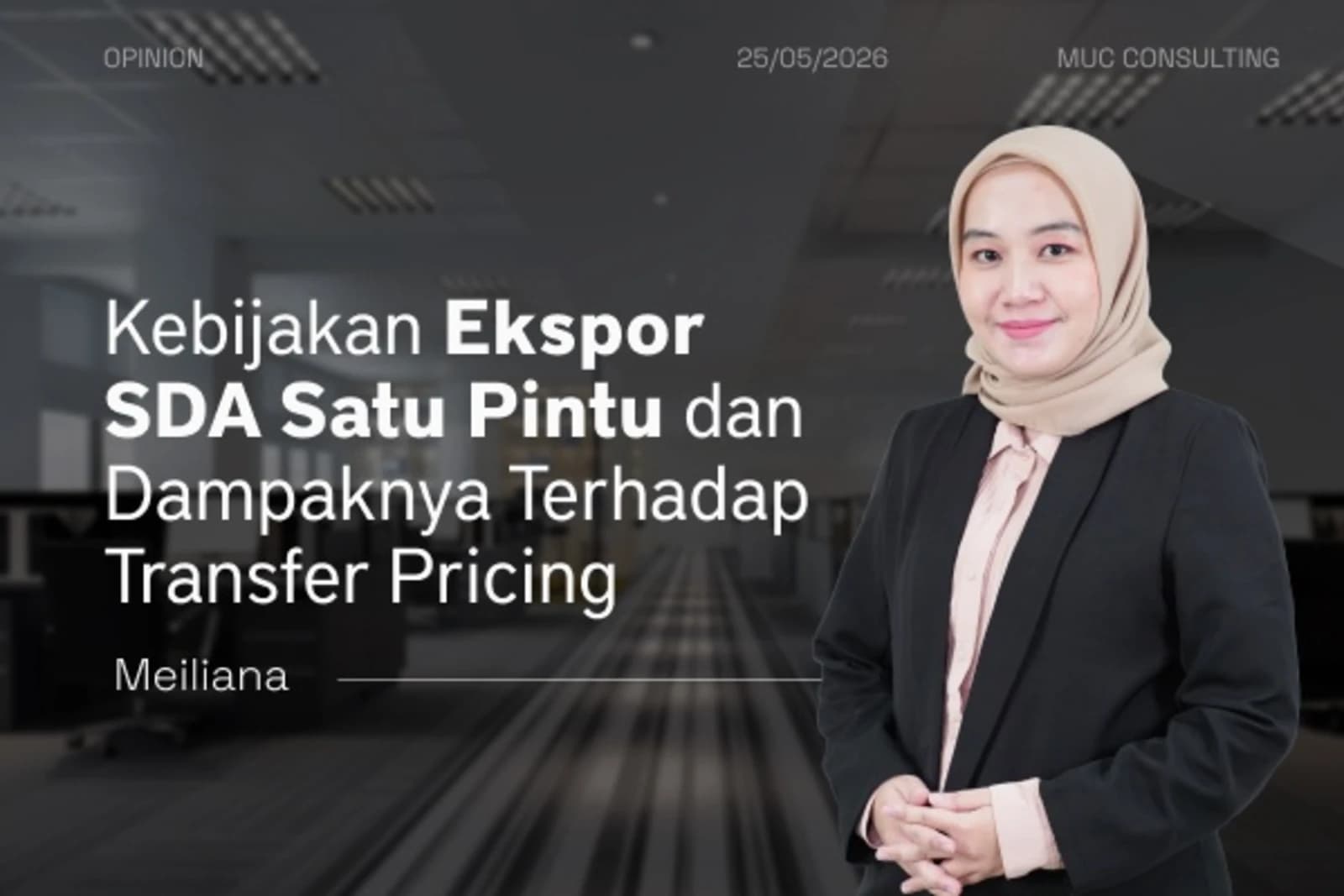
The government is preparing a major change in the governance of natural resource exports. One of the plans is the establishment of a dedicated state-owned enterprise (SOE) for exports.
This was conveyed by President Prabowo Subianto during a plenary session of the House of Representatives of the Republic of Indonesia. He stated that, going forward, natural resource export activities would be carried out through a single gateway, namely an export SOE.
Accordingly, exporters who have so far had the freedom to carry out exports would first be required to deliver their goods to the export SOE. At first glance, this policy may appear to be merely an issue of trade and foreign exchange management. However, from the perspective of international taxation, particularly transfer pricing, the impact may be far more significant than it appears on the surface.
To date, many natural resource companies in Indonesia have carried out export activities directly. Companies look for overseas buyers, negotiate prices, manage sales contracts, and receive export payments. In other words, these companies have performed the key functions in their own international trading chain.
However, under the new scheme, some of these functions would gradually shift to the SOE. Going forward, transactions, and possibly marketing activities with overseas buyers, would no longer be carried out directly by exporters. Instead, those activities would be conducted through the SOE acting as an intermediary or trading hub.
At this point, transfer pricing issues start to become relevant.
Changes in FAR and Potential Recharacterization
In transfer pricing analysis, changes in transaction structures are not only viewed from a contractual perspective but also based on changes in the functions, assets, and risks (FAR) performed or assumed by each party. When trading functions, customer relationships, and market risks began to shift to the SOE, the FAR profile of the exporting company would also change.
Previously, an exporter may have been regarded as a fully-fledged entity performing full strategic functions and, therefore, entitled to a larger margin. However, when trading activities began to be controlled by the SOE, the company may be positioned merely as a limited-risk entity.
In certain circumstances, the company may even be recharacterized as a:
• contract manufacturer; • toll manufacturer; or • limited-risk distributor.
This change in characterization is highly significant in transfer pricing because it directly affects the profit allocation considered to be at arm’s length for each party.
Shift in Tested Party and Benchmarking under TNMM
Changes in the business model may also affect the determination of the tested party in transfer pricing analysis.
Previously, the exporting company may have been tested as an entity with a relatively high margin. However, when strategic functions shifted to the SOE, the company might only be entitled to a routine return as a limited-risk entity.
As a result, the previously used benchmarking criteria may no longer be relevant. Comparable companies that were previously considered comparable may no longer reflect the same business profile, while the profit level indicator used may also potentially change.
That said, companies may need to reconstruct their entire transfer pricing analysis so that it remains aligned with the new business structure.
Pricing Issues and Profit Allocation
The centralization of exports through an SOE essentially creates a new transaction structure in the natural resource export trading chain. If exporters previously sold directly to overseas buyers or foreign group related parties, under this new scheme, transactions would first be conducted through the SOE before the goods are sold to overseas buyers.
This structural change not only alters the transaction flow but may also change the allocation of profits within the export trading chain.
From a transfer pricing perspective, the main issue arising is not merely the selling price of the goods but how profits should be allocated among the parties based on the FAR performed by each entity.
If the SOE began to take over strategic functions such as market access, customer relationships, contract negotiation, and market risk management, in theory, the SOE would also be considered entitled to a larger share of the profits. Conversely, if the exporting company continued to perform the key operational functions and assume significant economic risks, the exporter should also remain entitled to a certain level of profitability.
Therefore, this change in export structure may ultimately alter the profitability expectations considered to be at arm’s length for each party.
On the other hand, a decline in profitability at the exporter level under this scheme cannot automatically be viewed as an indication of profit shifting or non-arm’s length transfer pricing practices. In many cases, changes in margins may instead be a natural consequence of business restructuring and the transfer of strategic functions, market risks, and market control to the SOE as part of government policy.
For this reason, transfer pricing supervision in the future would likely require a more careful and more substantive approach. Tax authorities should not look only at changes in profitability levels but also understand the context of the business restructuring, changes in economic functions, and the effect of government intervention in shaping the new transaction structure.
Shift in the Focus of Transfer Pricing Supervision
Interestingly, this scheme may also reduce certain transfer pricing exposure at the exporter level.
To date, one of the most common transfer pricing disputes in the natural resource sector has arisen from direct export transactions with foreign related parties. In these circumstances, the Directorate General of Taxes (DGT) usually tests whether the export price charged to the related parties has complied with the arm’s length principle or whether there are any indications of underpricing to shift profits to another jurisdiction.
Under the new structure, exporters would no longer conduct direct transactions with foreign related parties but would first sell to a domestic SOE positioned as an independent party. As a result, controlled transactions at the exporter level may formally decrease significantly. In certain circumstances, this scheme may even serve as a kind of protective layer for exporters against transfer pricing disputes related to export pricing, particularly if the selling price to the SOE is determined using a market mechanism, certain pricing references, or a more transparent and standardized mechanism.
The change in natural resource export governance shows that trade, foreign exchange, and transfer pricing policies are becoming increasingly interconnected. The presence of an SOE as an intermediary in the export chain not only changes the trading mechanism but may also change how profit allocation, FAR profiles, and transfer pricing analysis are carried out in the natural resource sector.
On the one hand, this scheme may reduce certain transfer pricing exposure, particularly disputes related to direct export transactions with foreign related parties. On the other hand, this change in business structure may also create new dynamics in determining profitability, benchmarking, and profit allocation among the parties in the export transaction chain.
Therefore, the main challenge going forward will likely no longer be merely analyzing export prices charged to related parties, but understanding how changes in functions, risks, and business models resulting from the restructuring of export governance should be properly assessed from a transfer pricing perspective.
In this context, both the companies and tax authorities need to view changes in profitability and transaction structures more proportionally, particularly when such changes arise as a consequence of government policy and the restructuring of economic functions within the natural resource export trading chain. (ASP)
Disclaimer! This article is a personal opinion and does not reflect the policies of the institution where the author works.