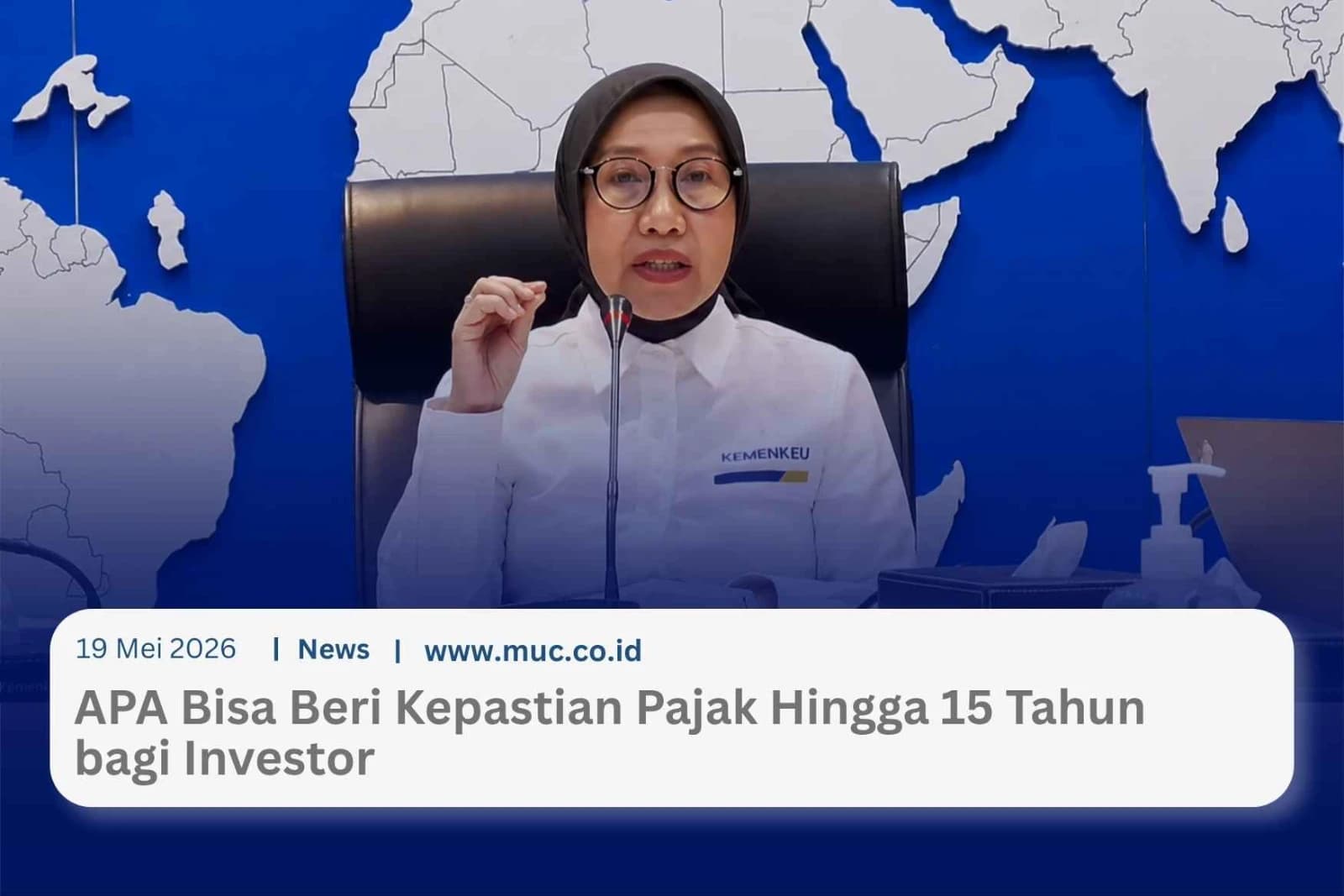
JAKARTA. The Directorate General of Taxes (DGT) has reaffirmed that an Advance Pricing Agreement (APA) can serve as an important instrument for providing long-term tax certainty to investors in Indonesia.
Dwi Astuti, Director of International Taxation at the DGT, said the protection period under an APA can extend to 15 years through a combination of the rollback mechanism, the agreement's validity period, and subsequent renewals.
Dwi made the remarks during the MUC Bicara Pajak (MUC BIJAK) webinar held on May 18, 2026.
According to Dwi, such certainty is particularly valuable for investors, especially multinational enterprises that require stability in managing the tax obligations arising from cross-border related-party transactions.
"Once again, this can provide up to 15 years of certainty for your investments in Indonesia with respect to your tax obligations," Dwi said.
He explained that an APA is an agreement between a taxpayer and the DGT on the transfer pricing method or pricing policy applicable to related-party transactions. Once concluded, transactions covered by the APA are generally no longer subject to transfer pricing audits, provided they remain consistent with the agreed terms.
Dwi further explained that the protection period may consist of multiple timeframes. An APA is generally valid for five years, may be renewed for another period, and may also include a rollback of up to five previous years, provided those years have not yet been audited.
However, he emphasized that such tax certainty applies only to the covered transactions and covered periods specified in the agreement.
Full Disclosure Is the Foundation of an APA
During the webinar, Dwi also stressed the importance of full disclosure throughout the APA application process. Taxpayers are expected to provide complete information, including supporting documents, business facts, and the terms and conditions of the relevant transactions, enabling the DGT to conduct a proper assessment.
According to him, an APA is fundamentally built on mutual trust between taxpayers and the tax authority. Transparency, therefore, serves as the foundation for ensuring that the agreement functions effectively and provides certainty to both parties.
Dwi added that if information later proves to be inaccurate or inconsistent with the actual facts, the APA may be reviewed or even revoked.
Nevertheless, he assured taxpayers that they should not hesitate to apply for an APA. If the APA process does not result in an agreement, the information and documents submitted during the process cannot be used as the basis for a tax audit.
According to Dwi, this safeguard is maintained through the separation of the teams responsible for Advance Pricing Agreements (APA) and Mutual Agreement Procedures (MAP) from those handling tax audits, objections, and appeals.
"The teams responsible for APA and MAP are separate from the audit, objection, and appeal teams," he said.
APA and MAP Strengthen Investment Certainty
Meanwhile, Wahyu Nuryanto, Transfer Pricing Partner at MUC Consulting, said the need for tax certainty has become increasingly important amid the growing volume of cross-border trade and investment.
According to Wahyu, globalization has led multinational enterprises to engage more actively in transactions with related parties across multiple jurisdictions, increasing both the risk of transfer pricing disputes and the potential for base erosion and profit shifting (BEPS).
"Without certainty, companies face the risk of disputes, high compliance costs, and investment uncertainty," Wahyu said.
He explained that an APA serves as a preventive solution by allowing taxpayers and tax authorities to agree on the transfer pricing methodology in advance. This enables businesses to carry out their commercial activities with greater confidence while providing tax authorities with a clear framework for oversight.
According to Wahyu, an APA is not merely an administrative tool but also an instrument for creating legal certainty, reducing disputes, and supporting a healthy investment climate.
At the same time, Wahyu noted that international tax disputes may still arise. For that reason, the Mutual Agreement Procedure (MAP) serves as a mechanism for resolving disputes between tax authorities in different jurisdictions.
He explained that MAP functions as a negotiation platform between competent authorities when differences arise in the interpretation of tax treaties or when taxpayers face the risk of double taxation.
"MAP is not merely a technical instrument but also a symbol of international cooperation in building a more stable tax system," he said.
According to Wahyu, APA and MAP complement one another. While an APA helps prevent disputes by providing tax certainty, MAP serves as a dispute resolution mechanism when cross-border tax disputes have already arisen.
He added that both instruments are essential to strengthening investor confidence and reinforcing Indonesia's commitment to international tax standards, including the OECD's BEPS Action Plan.
In closing, Wahyu emphasized that the successful implementation of APA and MAP depends on transparency, compliance, and strong cooperation between taxpayers and the tax authority.