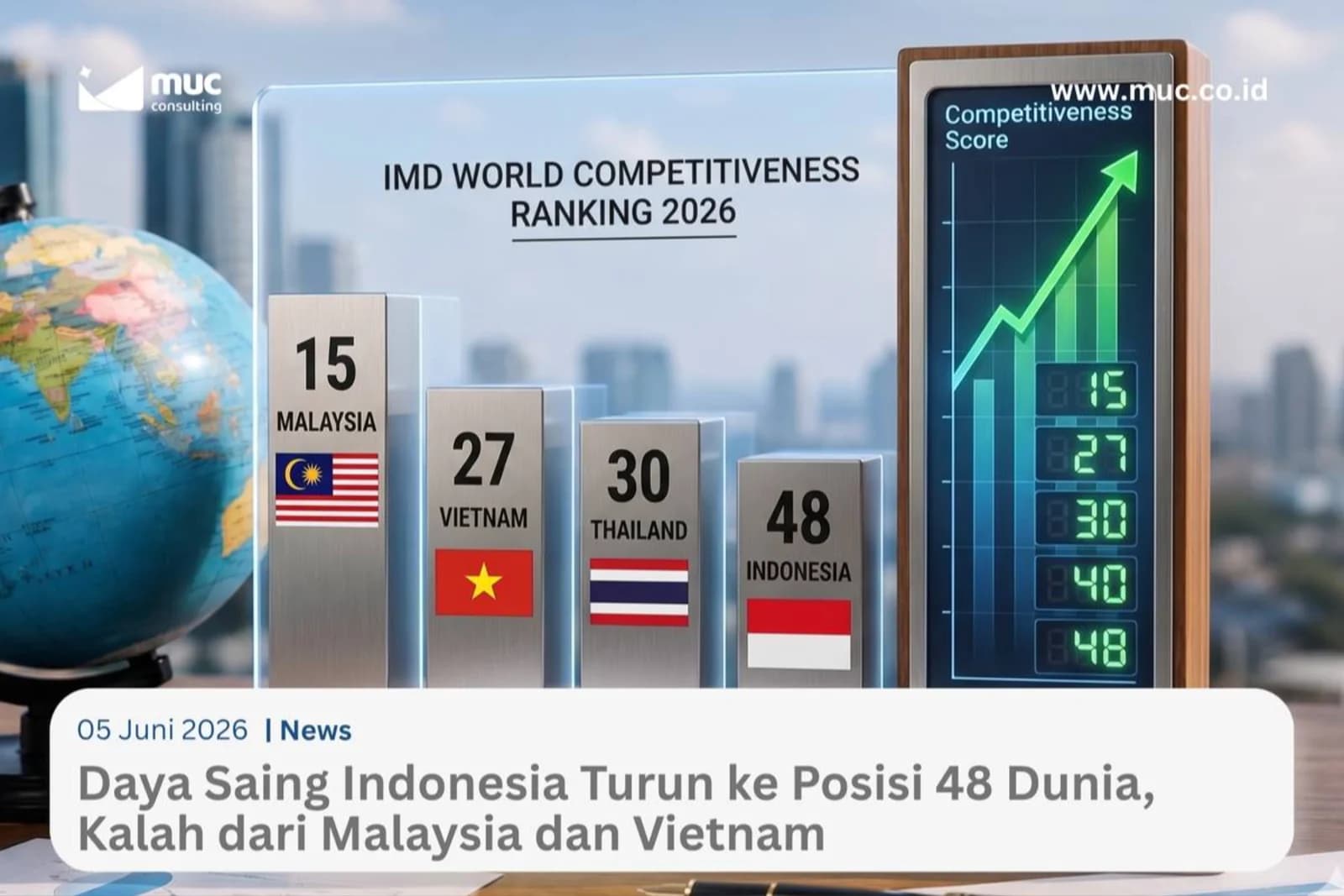
JAKARTA. Indonesia's position in the global competitiveness ranking has slipped once again. According to the IMD World Competitiveness Ranking (WCR) 2026, the country fell eight places to 48th out of 70 economies evaluated.
Within Southeast Asia, Indonesia ranked fifth, behind Singapore (1st), Malaysia (15th), Vietnam (27th), and Thailand (30th). The ranking indicates that Indonesia continues to lag behind several neighboring countries in fostering a competitive business environment, attracting investment, and improving economic productivity.
This marks a sharp reversal from 2024, when Indonesia reached 27th place globally. In contrast, Malaysia climbed eight spots to 15th, while Vietnam made an impressive debut in the IMD WCR by securing 27th place.
Infrastructure and Efficiency Remain Key Challenges
The IMD report shows that Indonesia continues to perform relatively well in economic performance, ranking 24th globally. However, this strength was not enough to improve its overall standing due to weaker performance in business efficiency, government efficiency, and infrastructure.
In 2026, Indonesia ranked 50th in business efficiency and 38th in government efficiency. Infrastructure remained its weakest pillar, placing 58th worldwide.
The IMD also identified several major challenges facing Indonesia this year, including rising global economic tensions, relatively stagnant economic growth, inadequate infrastructure and human capital, and limited access to financing.
In the IMD World Competitiveness Ranking 2026 release, Arturo Bris, Director of the World Competitiveness Center, said that competitiveness is no longer determined solely by the size of an economy or production costs, but increasingly by the quality of its institutions.
"Geopolitical conditions continue to deteriorate, while global fragmentation is intensifying. In this environment, countries with well-established and credible institutions will enjoy a significant competitive advantage," Bris said.
According to the IMD, strong institutions have become a critical asset for countries seeking to maintain competitiveness amid growing global uncertainty and an increasingly fragmented international trading system. (KEN)