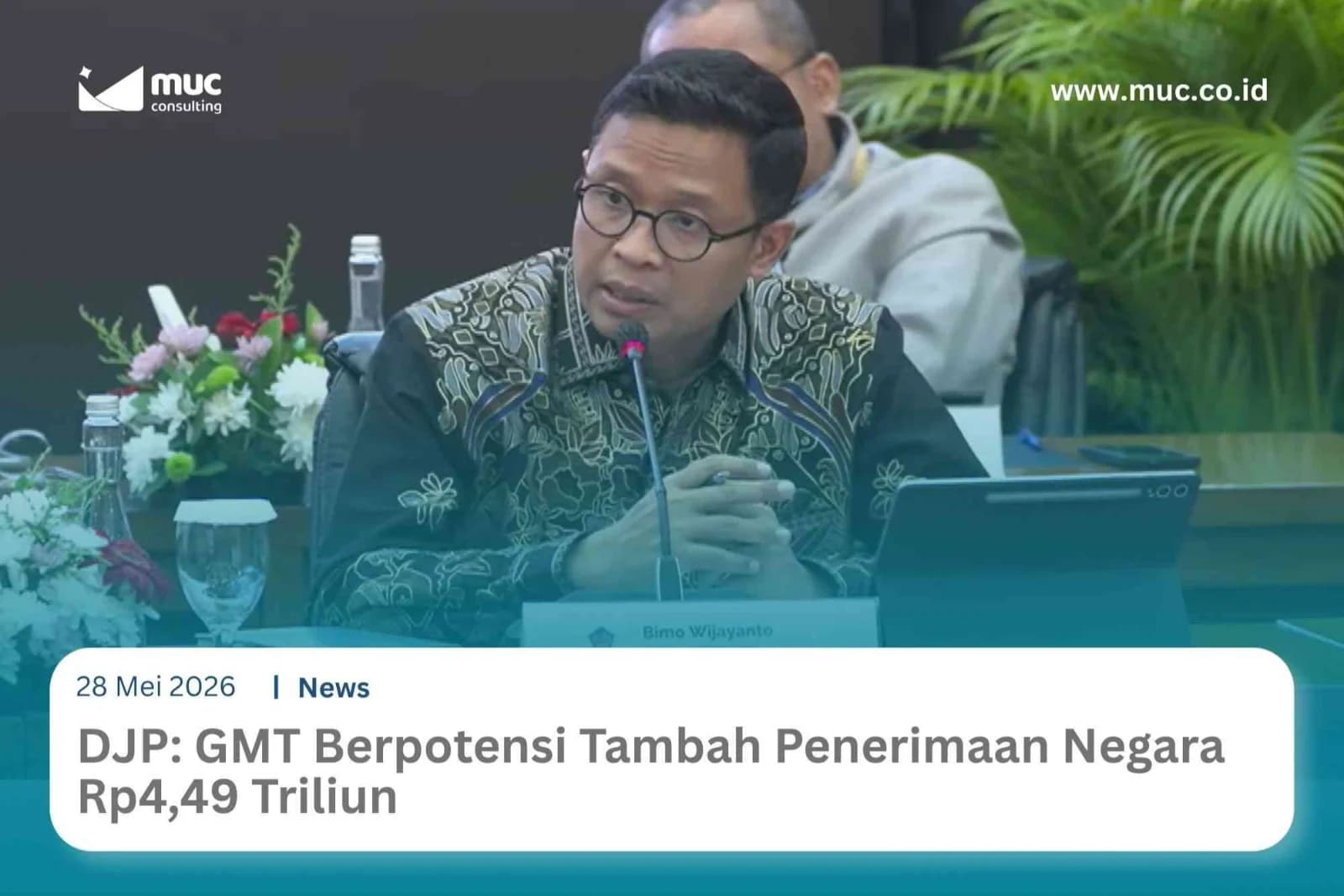
JAKARTA. Director General of Taxes Bimo Wijayanto said the implementation of the Global Minimum Tax (GMT) could generate up to IDR 4.49 trillion in additional state revenue. The estimate is derived from the three main GMT mechanisms.
According to Bimo, the largest contribution is expected to come from the Income Inclusion Rule (IIR), which is projected to generate IDR 4.41 trillion in additional revenue from four multinational enterprise (MNE) groups.
Meanwhile, the Qualified Domestic Minimum Top-Up Tax (QDMTT) is estimated to contribute an additional IDR 86.38 billion from three MNE groups.
"The largest potential comes from the IIR, amounting to IDR 4.41 trillion from four groups. In total, the estimated revenue from the three GMT mechanisms reaches around IDR 4.49 trillion," Bimo said during komPak Episode 4, titled Implementation of the Global Minimum Tax: Indonesia's Challenges and Readiness, on May 21, 2026.
The potential revenue from the Undertaxed Payment Rule (UTPR) is still being calculated. According to Bimo, the mechanism is more difficult to estimate than the IIR and QDMTT.
46 MNE Groups Meet GMT Reporting Requirement
Based on Country-by-Country Report (CbCR) data for the 2021–2024 period, around 722 business groups are expected to be affected by the Global Minimum Tax. Of these, 46 multinational enterprise groups meet the GMT reporting requirements.
"There are 46 multinational enterprise groups that meet the GMT reporting requirement based on the Country-by-Country Reports for 2021 to 2024," Bimo said.
The data serves as the basis for the Directorate General of Taxes (DGT) to identify business groups potentially affected by the Global Minimum Tax rules and estimate the additional revenue that could be generated from their implementation.
Tax Incentives to Be Adjusted
In addition to projecting higher tax revenue, the government has begun reviewing the design of its tax incentives following the implementation of the Global Minimum Tax.
According to Bimo, the incentives under discussion include accelerated depreciation, tax allowances, investment allowances, tax credits, super deductions, and incentives for vocational training activities.
He noted that when designing previous incentives, such as the super deduction and incentives for the electric vehicle industry, businesses often developed their own strategies to maximize the available benefits.
For that reason, the government continues to evaluate the design of tax incentives to ensure they remain effective and aligned with the Global Minimum Tax framework. (KEN)