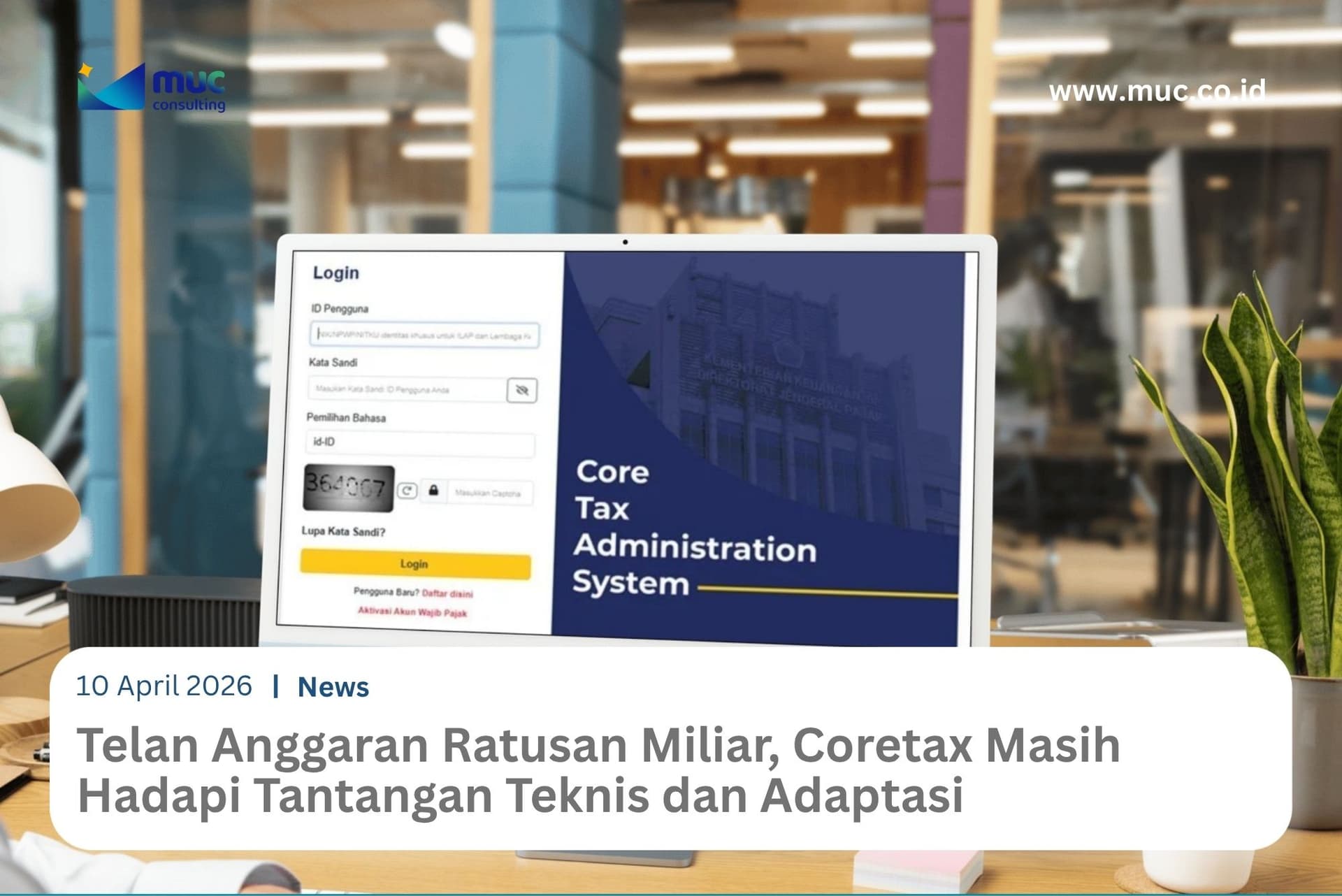
JAKARTA. The digital transformation of taxation through the Coretax system entered a crucial phase in 2025. The system has officially replaced the previous platform and now serves as the backbone of national tax administration. However, behind this ambitious shift lies a complex interplay between substantial budget allocation, implementation achievements, and ongoing field-level challenges that still need to be addressed.
Based on the 2025 Performance Report (LAKIN) of the Directorate General of Taxes (DGT), the government allocated a significant budget for the development and operation of Coretax. The ceiling reached approximately IDR 337.1 billion, with realization at IDR 136.8 billion. Part of the budget has even been carried over into the following year under a multi-year scheme, indicating that this is a long-term project not yet fully completed within a single budget cycle.
From an implementation standpoint, 2025 marked a major milestone as Coretax officially went fully live and replaced the previous system. It has successfully integrated 21 core tax business processes, including the Taxpayer Account Management feature, which allows taxpayers to access their obligations and entitlements in real time.
Implementation Progress and Emerging Efficiency
In terms of performance, Coretax implementation has shown several positive outcomes. The LAKIN report notes that the quality indicator for information system management exceeded its target, reaching 113.80%. Meanwhile, taxpayer compliance remained high at 95.89%, even during the transition to the new system.
Digitalization has also significantly transformed tax return filing. Through the pre-populated tax return feature, taxpayer data is automatically filled based on information from withholding agents or tax collectors, reducing the risk of input errors. The government has also intensified education efforts, with the tax education effectiveness index reaching 120% of its target.
From a budget perspective, the focus in 2025 has begun shifting from system development toward maintenance, stability, and infrastructure strengthening, indicating that Coretax has moved beyond its initial development phase and entered the optimization stage.
However, these achievements do not fully reflect the situation on the ground.
Technical Issues, User Adaptation, and “Jockey” Risks
Amid full implementation, Coretax still faces several technical and user adaptation challenges. The report highlights system bugs, access constraints, and the time needed for both taxpayers and officers to fully understand the new business processes.
This was also acknowledged by the Minister of Finance, Purbaya Yudhi Sadewa, who pointed out that the system design is not yet fully user-friendly.
“The design is indeed somewhat difficult for ordinary users, which is why intermediaries or interface software have emerged to bridge Coretax and users,” Purbaya said, as quoted by Kompas.com.
Nevertheless, the emergence of such “jockey” services is merely a derivative effect of a more fundamental issue, system usability. From an economic perspective, he noted that intermediaries tend to arise whenever there is a gap or opportunity. “In economics, if there is an opportunity, someone will step in,” he added.
On the other hand, the Directorate General of Taxes (DGT) warned that the use of such services poses serious risks. The Director of Counseling, Services, and Public Relations at DGT, Inge Diana Rismawanti, revealed that offers for Coretax “jockey” services are increasingly widespread on social media at very low prices.
“There are Coretax jockey services offering to handle everything for just IDR 20,000. For an additional IDR 50,000, they can even file a nil tax return,” she said, as quoted by Kontan.co.id.
According to her, such offers risk exposing sensitive taxpayer data, including National Identity Numbers (NIK), Taxpayer Identification Numbers (NPWP), and account passwords. “We never truly know what someone could do with our personal data and access to our tax accounts,” she added.
The DGT emphasized that taxpayer data protection is strictly regulated under Article 34 of the Law on General Provisions and Tax Procedures (KUP Law). Therefore, the public is urged to manage their tax obligations independently or through official channels.
Going forward, the government aims to further refine Coretax through system simplification, improved stability, and stronger data integration and security. “Moving ahead, we will fix it so Coretax will no longer require intermediaries,” Purbaya concluded. (KEN)