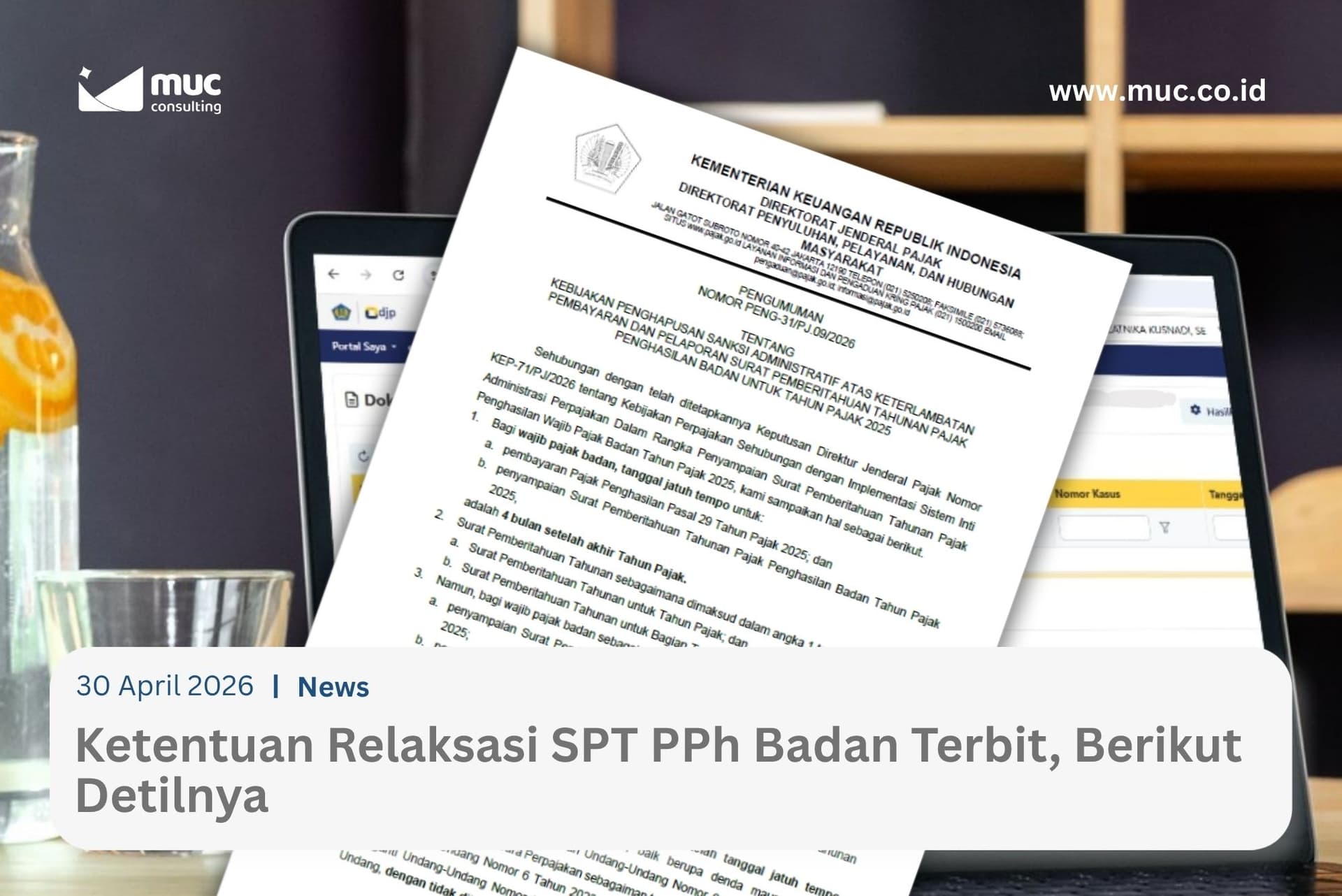
JAKARTA. The Directorate General of Taxes (DGT) has officially introduced a filing relief policy by waiving administrative sanctions for the late submission of 2025 Annual Corporate Income Tax Returns and late payment of Income Tax Article (ITA) 29 beyond the statutory deadline.
The policy is stipulated in Announcement No. PENG-31/PJ.09/2026, issued on April 30, 2026.
The announcement refers to the Director General of Taxes Decree No. KEP-71/PJ/2026. The filing relief was introduced to support the implementation of the DGT Coretax System, which remains in an adjustment phase for both the tax authority and taxpayers.
Under the announcement, the DGT reiterated that the normal deadline for paying Income Tax Article (ITA) 29 and filing Annual Corporate Income Tax Returns is four months after the end of the tax year. However, under this policy, corporate taxpayers are granted additional time without being subject to administrative sanctions.
"Corporate taxpayers that file their Annual Corporate Income Tax Returns and/or pay Income Tax Article (ITA) 29 after the statutory deadline, but no later than one month thereafter, will not be subject to administrative sanctions," the announcement states.
Scope of the Filing Relief
The DGT's filing relief covers:
Late submission of 2025 Annual Corporate Income Tax Returns;
Late payment of Income Tax Article (ITA) 29; and
Settlement of underpaid taxes, including returns filed under an approved filing extension.
The DGT also confirmed that the waiver applies to both administrative fines and interest, and that Tax Collection Letters (STPs) will not be issued during the filing relief period.
How the Administrative Sanctions Are Waived
The waiver of administrative sanctions will be applied automatically by not issuing Tax Collection Letters (STPs) to eligible taxpayers who utilize the filing relief period.
If an STP for late filing or late payment has already been issued, the DGT's regional offices will cancel the administrative sanctions ex officio, without requiring taxpayers to submit a request.
Inge Diana Rismawanti, Director of Tax Dissemination, Services, and Public Relations at the DGT, said the policy is intended to help taxpayers adapt to the transition toward the new tax administration system.
She added that where administrative sanctions have already been imposed, the DGT's regional offices will revoke them ex officio.
The filing relief also reflects the DGT's approach of providing taxpayers with a reasonable transition period while maintaining the importance of timely tax filing and payment. (KEN)