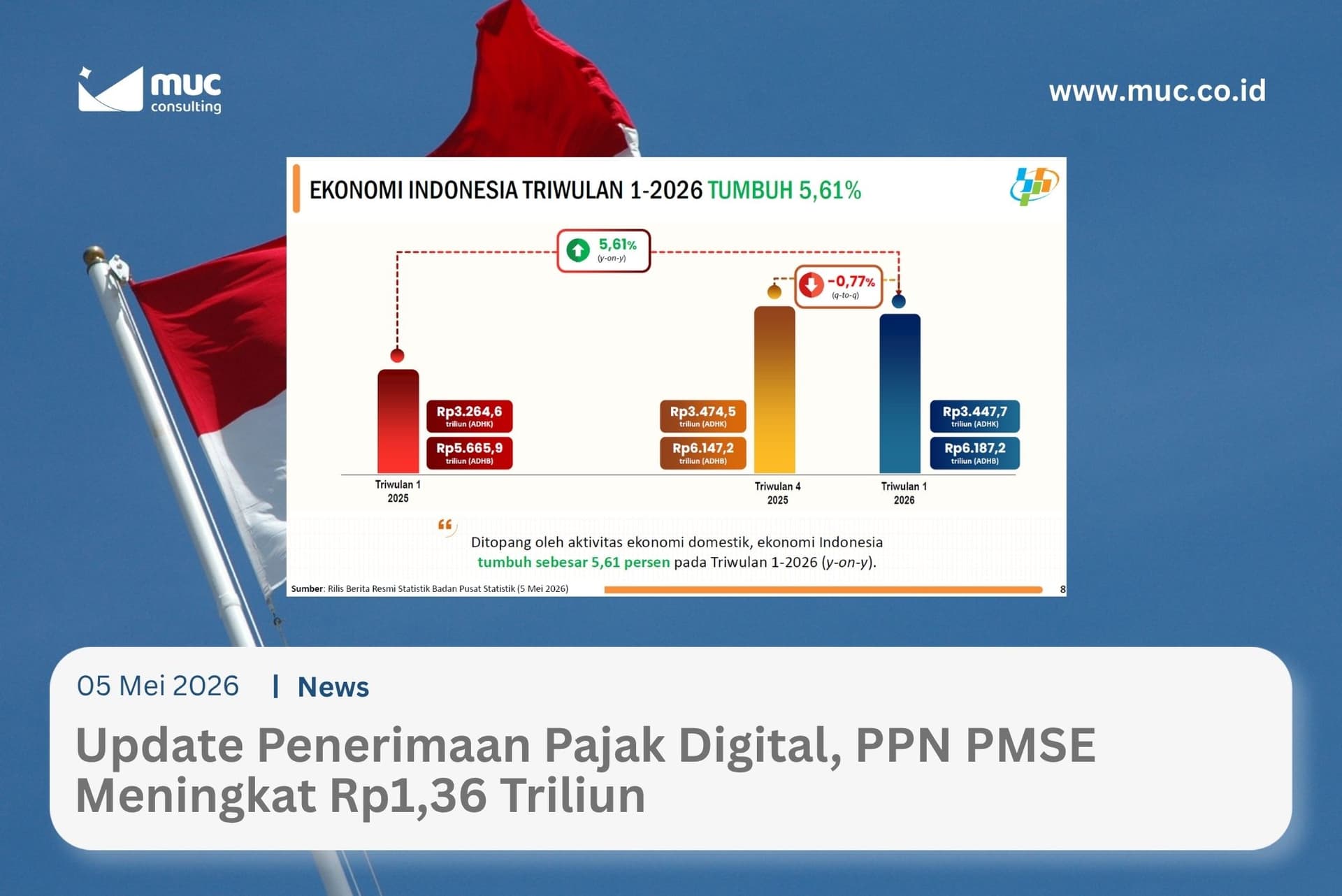
JAKARTA. Indonesia's economy grew 5.61% year on year (YoY) in the first quarter of 2026, according to data released by Statistics Indonesia (BPS). The country's economic performance was measured based on Gross Domestic Product (GDP).
Indonesia's GDP at current prices reached IDR6,187.2 trillion in the first quarter of 2026, while GDP at constant 2010 prices stood at IDR3,447.7 trillion.
Among the expenditure components, government spending recorded the highest growth, expanding 21.81%, although it accounted for only 6.72% of GDP.
The increase in central government spending was supported by higher personnel expenditures for the payment of the holiday bonus (THR) and goods expenditures under the Free Nutritious Meals (MBG) Program.
Other Growth Components
Household consumption, which contributed the largest share of GDP at 54.36%, grew 5.52% during the period. Meanwhile, Gross Fixed Capital Formation (GFCF), or investment, expanded 5.96%, contributing 28.29% to GDP.
Exports and Non-Profit Institutions Serving Households (NPISH) consumption grew 0.90% and 6.28%, respectively, contributing 21.22% and 1.40%. Meanwhile, imports increased 7.18%, with a contribution of -20.29% to GDP growth.
Sectoral Economic Growth
Indonesia's 5.61% economic growth was primarily supported by the manufacturing sector, which contributed 1.03 percentage points to overall growth. The sector benefited from strong domestic and international demand.
Within manufacturing, the food and beverage industry expanded 7.04%, driven by higher demand during Ramadan and Eid al-Fitr. The fabricated metal products, computer, electronic, optical products, and electrical equipment industry grew 10.35% due to robust overseas demand for electronic products and batteries.
Meanwhile, the chemicals, pharmaceuticals, and traditional medicine industry recorded 7.41% growth, supported by higher production to meet both domestic and export demand.
Other sectors also contributed to economic growth, including trade (0.82 percentage points), agriculture (0.55 percentage points), construction (0.53 percentage points), and other sectors (2.68 percentage points).