Amid increasingly complex tax regulations and growing demands for transparency, companies can no longer rely on traditional approaches to managing their tax obligations. Such approaches often lead to prolonged disputes and high compliance costs.
This issue has evolved into a global concern. Over the past two decades, tax administration has undergone a fundamental transformation, from a traditionally confrontational, enforcement-based approach toward a more collaborative, trust-based relationship between tax authorities and taxpayers.
The OECD, in its report Co-operative Compliance: A Framework – From Enhanced Relationship to Cooperative Compliance (2013), emphasizes that effective relationships between tax authorities and taxpayers can no longer rely solely on ex-post audits, which are considered insufficient to address the complexity of modern transactions.
Instead, the Cooperative Compliance (CC) paradigm is required, one that emphasizes transparency, trust, continuous communication, and a collaborative relationship between tax authorities and taxpayers. At its core lies a fundamental proposition: transparency in exchange for certainty.
In practice, however, a trust-based approach cannot be understood naively as unconditional trust. The OECD introduces the concept of “justified trust” trust built not merely on good faith, but on objective, verifiable evidence of effective governance, systems, processes, internal controls, and tax risk management that provide reasonable assurance of tax compliance.
It is where the Tax Control Framework (TCF) emerges as a critical foundation for sustainable tax compliance. In 2013, the OECD published A Framework – From Enhanced Relationship to Cooperative Compliance.
As a follow-up, in 2016, OECD issued Cooperative Tax Compliance: Building Better Tax Control Frameworks. Although published nearly a decade ago, its substance remains relevant as a reference for taxpayers seeking to manage tax risks over the long term.
TCF serves as a core pillar of CC. It is an internal control system integrated within a company’s broader internal control system to ensure that tax controls operate effectively, and that tax risks are managed reliably.
TCF ensures that tax calculation and reporting processes do not merely satisfy formal administrative requirements but reflect substantive compliance, resulting in accurate, complete, and timely tax reporting. Through this article, the author aims to reiterate the importance of these OECD publications and encourage taxpayers to consider implementing a reliable TCF to better manage future tax risks.
Definition of TCF
The OECD’s 2016 publication explains that the TCF is a critical component of a company’s internal control system. It is designed to ensure the accuracy and completeness of tax returns and tax disclosures made by taxpayers.
Beyond mere compliance, the TCF forms the foundation of Cooperative Compliance—a model of engagement between large taxpayers and tax authorities based on trust and transparency. Without the TCF, trust within CC risks being unfounded. Conversely, without CC, the TCF does not deliver optimal benefits in terms of tax certainty.
For Multinational Enterprises (MNEs) participating in CC programs, it is essential that senior management and executive leadership understand three key aspects: the objectives and importance of the TCF, their responsibilities in managing tax risk, and their commitment to enhanced transparency with tax authorities.
Although the TCF implementation varies across jurisdictions due to differences in tax systems, the adopted approach reflects best practices through a top-down model, whereby controls are established at the senior management level rather than derived from operational-level decisions.
Objectives of TCF
The importance of the TCF lies in its ability to provide verifiable assurance that taxpayer information and tax returns are accurate and complete. Within the CC framework, the TCF places significant emphasis on two elements: disclosure and transparency.
Disclosure refers to the willingness of taxpayers to proactively inform tax authorities of any potentially controversial tax positions, often going beyond statutory disclosure requirements. Transparency, on the other hand, involves sharing information regarding the design, implementation, and effectiveness of internal control systems and tax management, including the TCF, ensuring that taxpayers are fully aware of and in control of their tax positions and issues requiring disclosure.
A well-designed and tested TCF serves as tangible evidence underpinning the trust granted by tax authorities to taxpayers. In return, tax authorities are able to provide greater certainty regarding disclosed tax positions.
Six Principles of TCF According to the OECD
Corporate internal control systems are generally based on the COSO framework. However, internal control systems must reflect the relevant business and industry conditions. Therefore, there is no “one size fits all” model applicable to all companies.
The same applies to TCF. Accordingly, the OECD’s 2016 publication outlines the principles that should underpin effective TCF implementation. The principles are referred to as the six essential building blocks:
-
Tax Strategy Established
The TCF must reflect and document a company’s tax strategy and objectives. A strategy constitutes a long-term action plan, which should transparently articulate the overall tax approach—from strategic to operational levels—including tax risk strategy, risk tolerance, senior management involvement in tax decision-making, reporting, documentation, and payment.
2. Applied Comprehensively
To be effective, the TCF must be embedded within the company’s activities and reflected in documented policies, rules, procedures, and processes covering all relevant tax risks, rather than existing merely as a formal document.
3. Responsibility Assigned
The board of directors holds primary control, while the tax division executes the strategy with adequate support. Besides, successful implementation also requires qualified and experienced human resources.
4. Governance Documented
A robust TCF should reflect sound tax governance, beginning with alignment between the risk committee and clearly articulated tax governance policies. Tax governance should define responsibilities, accountability, KPIs, communication methods, materiality thresholds for tax purposes, tax risk monitoring and mitigation, and TCF testing.
5. Testing Performed
A TCF must be regularly tested and monitored to remain aligned with business and regulatory changes. Monitoring activities should provide feedback and corrective measures to enhance TCF quality and prevent recurring errors.
6. Assurance Provided
A well-functioning TCF should provide assurance to stakeholders—including external parties such as tax authorities—that tax risks are subject to adequate controls and that reported tax returns are reliable. This assurance strengthens confidence that tax risks are effectively managed.
Conclusion and Recommendations
A robust TCF delivers significant benefits to both taxpayers and tax authorities. By implementing the six essential building blocks, taxpayers can establish a credible internal control system, minimize risks, and foster trust within a Cooperative Compliance framework.
For tax authorities, a TCF provides greater certainty regarding taxpayer positions without requiring excessive intervention.
The Indonesian government, through the Directorate General of Taxes (DGT), is actively assessing and preparing the implementation of CC and TCF programs.
This initiative is strategically aimed at reducing compliance costs for taxpayers and minimizing dispute-related costs—both of which typically arise after tax reporting. Therefore, taxpayers, particularly large taxpayers, are encouraged to consider integrating a TCF into their existing internal control systems.
Such a proactive approach will ensure effective tax risk management and position taxpayers optimally to participate in and derive maximum benefit from the CC program currently being developed by the DGT. (ASP)
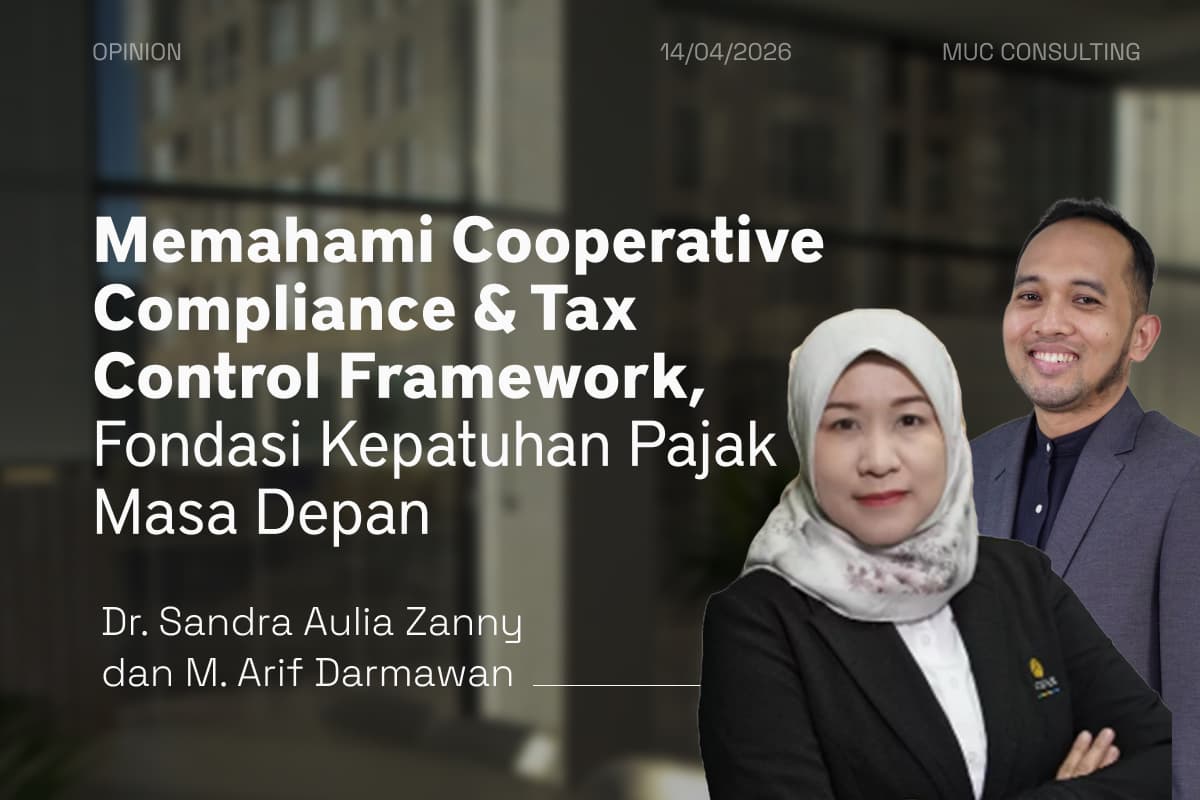
About the Authors
1. Dr. Sandra Aulia Zanny
Dr. Sandra Aulia Zanny is a lecturer and academic at the Vocational Education Program of Universitas Indonesia, holding the position of Associate Professor. She specializes in accounting and taxation and is actively engaged as a tax author and audit committee member.
2. M. Arif Darmawan
M. Arif Darmawan is the Head of Tax Governance Services, with extensive experience in international taxation and cross-border advisory. He brings deep expertise in transfer pricing, which he integrates with tax governance and risk management practices.
Disclaimer! This article is a personal opinion and does not reflect the policies of the institution where the author works.